Introduction
What CaughtLeads does, in plain English.
On this page
CaughtLeads answers your phone. That’s the whole idea.
It picks up the calls that come in while you’re on a roof or under a sink or asleep, works out what the customer needs, writes down their details, and puts the job on your calendar. You keep your number. You don’t hire anyone. You forward your calls and they get answered.
The phone is where the money leaks
Most home-services businesses don’t have a marketing problem. They have a Tuesday afternoon problem.
Someone with a dead furnace rings three companies and hires whichever one picks up. Not the best one. The available one. If you’re halfway through a job when they call, that isn’t you, and the worst part is you never find out what it was worth.
With CaughtLeads
Without CaughtLeads
With CaughtLeads
What a call sounds like
It isn’t a phone menu, and it isn’t a voicemail box with extra steps. It has a conversation.
Sample call
While that’s going on it’s doing four things at once: answering questions from what you’ve told it, judging how urgent the job is, collecting the details you need before anyone drives out, and checking your real calendar so the time it offers is a time you’re actually free.
What you get afterwards
- The lead, with name, phone, address and what the job is
- A full transcript of the call and a short summary
- The appointment on your calendar, if they picked a time
- An alert when a call books or needs you: by email, and by text once your texting registration is approved
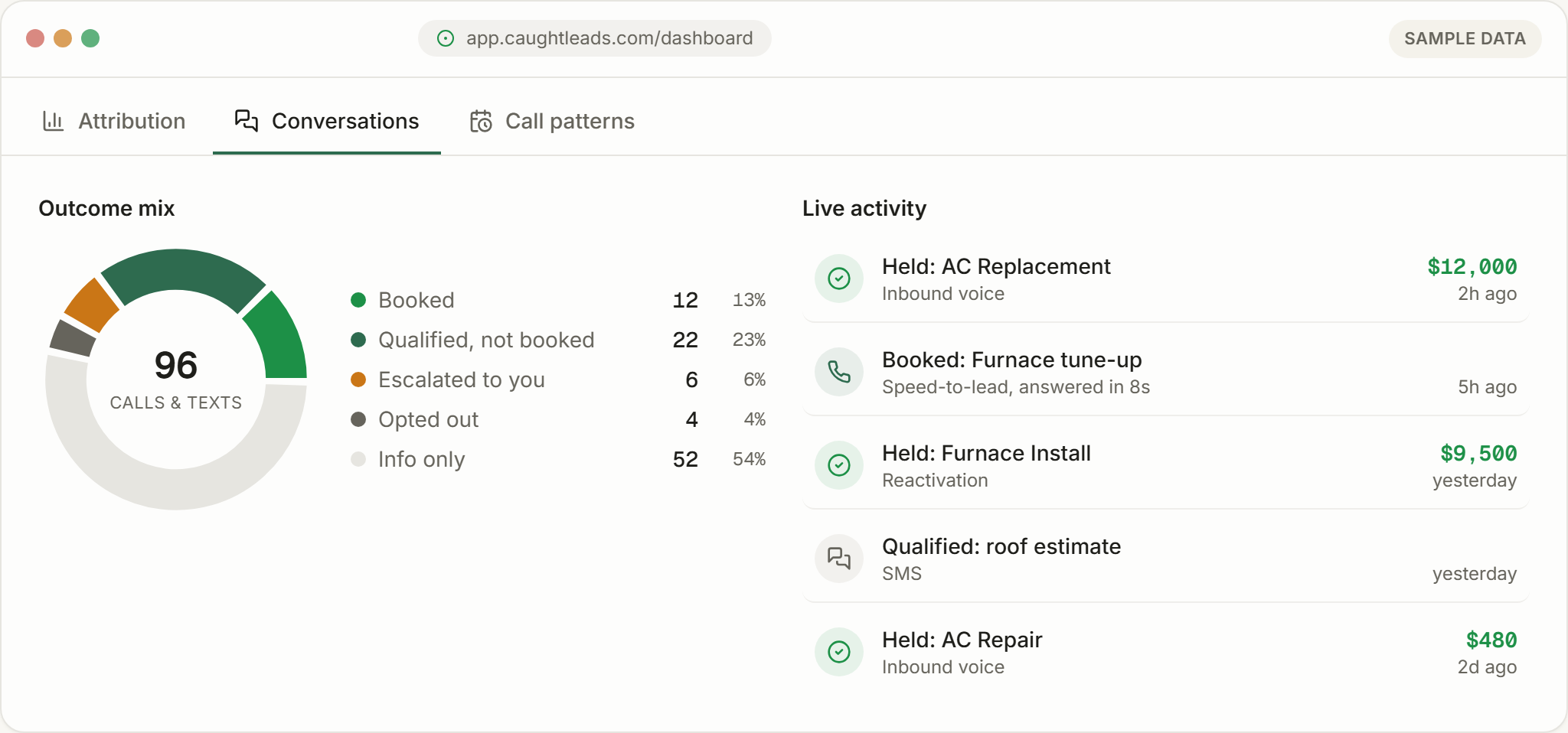
- A monthly picture of what came in and how much of it actually held
Things it deliberately won’t do
Worth knowing early. These come up on your first day, and they’re all choices rather than gaps.
- It says it's an AI
- At the start of every call, along with a note that the call may be recorded and how to opt out. That's the law in a lot of places. In practice callers care far more about being answered than about who answered.
- It won't guess
- Ask it something you haven't told it and you get 'someone will follow up' plus a captured lead. It will not invent a price. That feels cautious right up until the day a customer asks about something you'd never have thought to write down.
- It won't take work you don't do
- List the jobs you turn down and it turns them down politely, instead of booking a visit you'd have to cancel.
- It won't message people who opted out
- Permanently, and enforced by the system rather than left for you to remember.
Honestly, just ring it
A few words you’ll see everywhere
These turn up on every screen, and each one means something specific.
- Lead
- A caller whose details got captured. One call, one lead.
- Booked
- They agreed a time and it went on your calendar.
- Held
- The appointment actually happened. Nobody cancelled, nobody no-showed. This is the one that carries money.
- Recovered revenue
- What those held appointments were worth. Never a forecast, and never a projection of what a lead 'could' be worth.
Forty calls in a month might mean thirty-four leads, nineteen bookings and sixteen that held. At an average job value of $480 that’s $7,680 of work, all of it starting with a phone nobody was free to answer.
Where to start
If you have fifteen minutes, do the setup. If you have two, make a test call first and see what you think.