Call Behavior
Tone, questions asked, and when it books versus takes a message.
On this page
Call behaviour is how your receptionist runs a conversation — what it asks, in what order, who it treats as a good fit, and what it must have before the call ends.
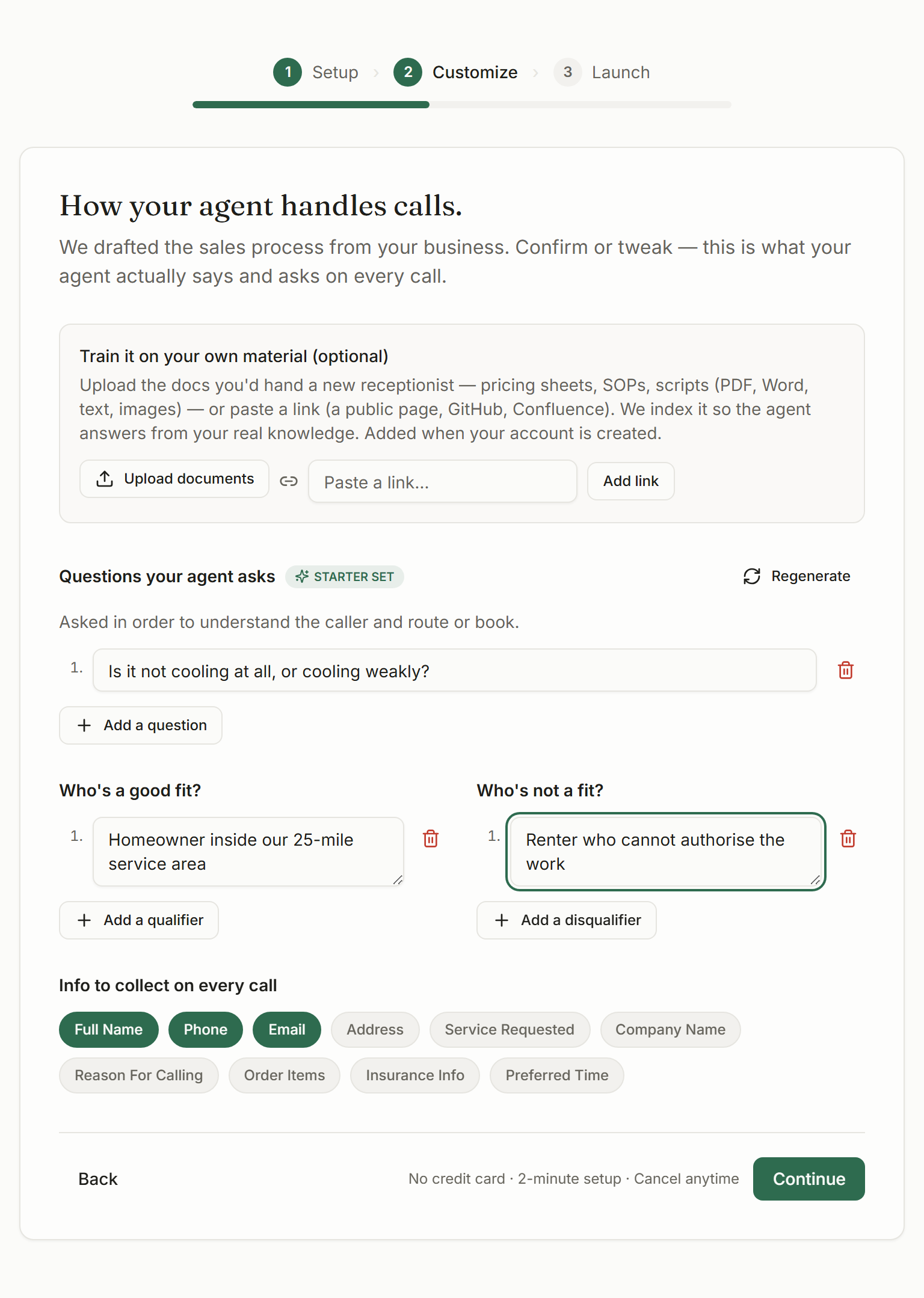
Two businesses, same trade, different calls
Two businesses in the same trade need different calls. A firm doing emergency repairs needs urgency triaged first; one doing installs needs budget and timeline. The default is a reasonable starting point, not the finished thing.
The questions it asks
The follow-ups that narrow a vague problem into a job you can price and schedule. Write them in the order you’d ask them yourself.
A good question set for HVAC
1. Is this a home or a commercial property?
2. Is it not cooling at all, or cooling weakly?
3. Is the outdoor unit running, or completely silent?
4. How long has it been like that?
Four questions and you know whether it’s a capacitor, a breaker or a full failure — before anyone drives out.
Order matters more than quantity
Who is a good fit
Two short descriptions — who you want, and who you don’t — let your receptionist spend its effort on the callers worth booking.
- A good fit
- e.g. 'Homeowner inside our service area, with a heating or cooling problem they can authorise work on.'
- Not a fit
- e.g. 'Renter who can't authorise the work, commercial rooftop units, anything outside 25 miles.'
A caller who isn’t a fit still gets a courteous call and their details are still captured — it just won’t book them a slot you’d have to cancel.
What it collects every time
The details you can’t start a job without. Name, callback number and address are the usual baseline; add whatever your trade needs.
Make and model of the unit, roughly how old it is, whether there’s a maintenance plan.
Whether the water is off, whether it’s actively leaking, where the stopcock is.
Property height, roof type, whether there’s active water ingress.
Buying or selling, timeline, whether they’re already with an agent.
Handling pushback
Callers object. “That’s more than I expected.” “Can you come sooner?” “I’m getting other quotes.” You can write how your receptionist should respond to each.
An objection, answered
Sample call
Write these in your own words. The ones that work are the answers you already give in person.
Tone and personality
Warm, brisk, formal — pick what suits your customers. A domestic emergency service and a commercial contractor should not sound alike.
Tone doesn't override honesty
Judging a behaviour change
Changes apply on the next call. Ring in and run a realistic scenario — behaviour changes are harder to judge from reading than a price change is.
Cut the collect-every-time list to what you genuinely can’t start without. Anything you could ask when you arrive doesn’t need to be asked on the phone.