Playbook
Your Best Blog Topics Are Sitting in Your Phone Calls
CaughtLeads · CaughtLeads · October 13, 2026
Contractors pay agencies to guess what customers search for. Your callers tell you every day, in their own words. Here is how to turn last month's calls into pages worth publishing.

Nobody knows what to write, so nothing gets written
Ask a contractor why their website has three pages and no blog, and the answer is rarely money. It is that they do not know what to write about, and the blank page wins.
So either nothing happens, or they hire an agency that produces four articles a month about thermostat efficiency that nobody searches for and nobody reads. Six months later the owner concludes that content does not work for the trades, cancels, and goes back to renting clicks from Google forever.
Content can work. The topics were just wrong, and they were wrong because somebody guessed.
You are already being told, every week
Every day, people ring your office and describe their problem out loud, in their own words, about their own house, in your own town.
"Why is it blowing warm air but the fan is still running?"
"How much is a whole new unit, roughly?"
"Do you even come out to Mesa?"
Those are not just phone calls. They are search queries that happen to be spoken. The same person, two hours earlier, may well have typed something very close to that into Google. Whoever had the page that answered it got the click.
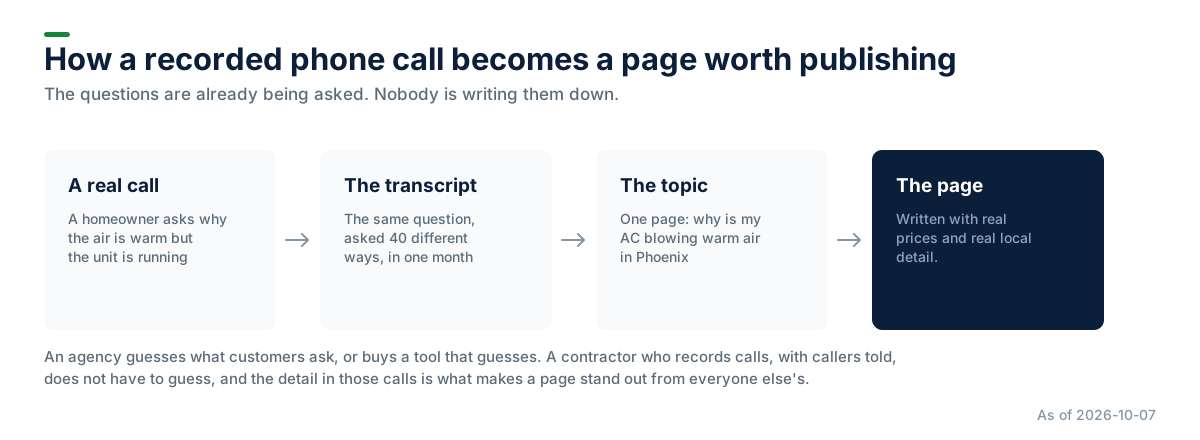
An agency buys a keyword tool and gets a list of phrases with search volumes attached. That is a guess dressed up as data. A contractor who listens to their own calls has the actual sentences, from actual buyers, in the actual town they serve.
Write the three kinds of page in the right order
Not everything is a blog post, and blogs are not where you start.
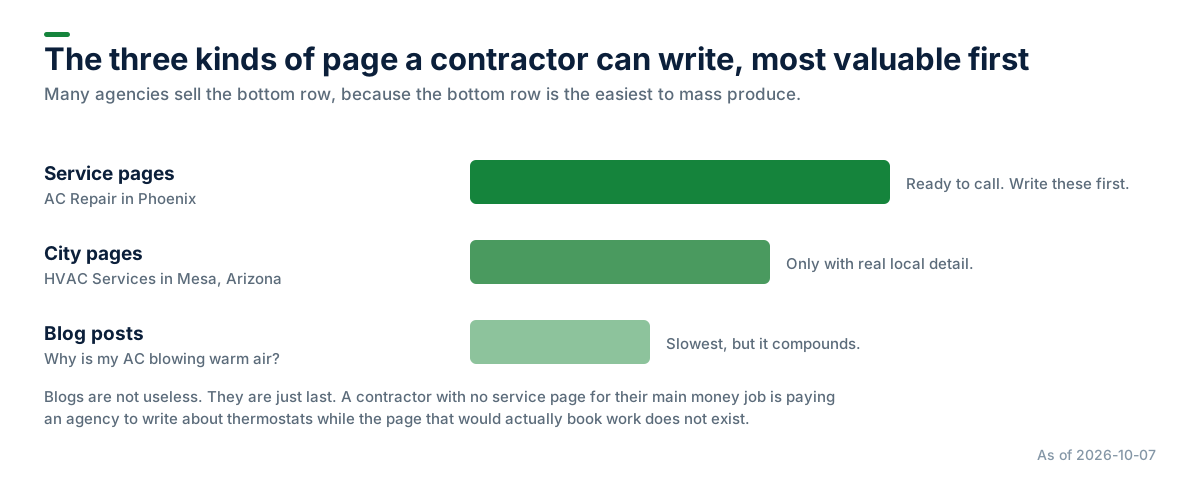
Service pages come first. One page for each thing you actually sell, in the town you are based in. "AC Repair in Phoenix." Somebody searching that is ready to call today. If you do not have a page for your biggest money job, nothing else on this list matters yet.
City pages come second, and only where you have something real to say. One for a town you genuinely cover, with real local detail: the jobs you have done there, the kind of houses, the questions people there ask. Do not expect it to move you in the map box, which follows where your Business Profile is. A set of pages that only swap the town name is what Google's spam policy describes as doorway abuse, and it does more harm than good.
Blog posts come third. "Why is my AC blowing warm air?" catches somebody earlier, before they know whether they need a repair or a replacement. Slower to pay off, but it compounds, and it is where the call questions fit best.
The reason generic content does not rank
There is a trap worth naming, because it is where most automated content ends up.
Google pushes down mass-produced pages that say nothing specific. Pointing an AI at a keyword list and publishing two hundred articles is a known way to get buried rather than ranked, and it can drag down the whole site, not only the bad pages.
What makes a page worth ranking is first-hand detail. A real price range. A real local name. A real situation described the way it actually happens. Generic writing has none of that, and both Google and the homeowner can tell within a paragraph.
This is exactly why the calls matter. They are the first-hand material. A page written from dozens of real conversations about warm air in July contains things no keyword tool knows: what people tried first, what they assumed it would cost, what they were actually afraid of.
From a list of questions to a page
Group the questions. Forty different ways of asking about warm air is one topic, not forty. Write one good page for it.
Use the question, never the caller. No names, no addresses, nothing that identifies who rang. The page answers what people ask, not what one person said.
Put the real detail in. The price range you actually quote, the cause you actually find, the town you actually drive to.
Have a person read every page before it goes live. Four good pages a month beat forty bad ones, and forty bad ones actively hurt you.
Start with what you have
You can do a rough version of this yourself with a notepad.
Keep a list by the phone for two weeks and write down every question a caller asks, in their words. At the end, count which ones came up more than three times, and write one page answering the most common one properly, with a real price range and a real example. Then check you have a page for every service you sell.
If you use CaughtLeads, your call transcripts are already in your dashboard. That is your list.
The honest timeline for when any of this starts working is in local SEO for contractors, and the faster half of getting found is Google reviews.
Never miss another lead like the ones in this story
Try it free: we'll fine-tune an AI receptionist to your business, then test it on a real call.
Try it freeMore Field Notes
 Guides
HVAC Lead Generation: Why More Leads Won't Fix Your Problem
Struggling to find leads for your HVAC business? Most contractors already have more than they think. Here is where they go, and how to catch the ones you already have.
 Guides
How to Get More Google Reviews Without Breaking Google's Rules
Reviews are the Google Maps ranking input a contractor can most directly influence. Here is when to ask, what to send, the shortcut that can get your reviews taken down, and how to keep it going.
 Guides
Local SEO for Contractors: What Works and How Long It Takes
As a rough rule of thumb, reviews can move in weeks, pages can take months, and ads stop the day you stop paying. An honest timeline for local SEO, the order to do it in, and how to spot a bad agency.