Guides
HVAC Lead Generation: Why More Leads Won't Fix Your Problem
CaughtLeads · CaughtLeads · October 13, 2026
Struggling to find leads for your HVAC business? Most contractors already have more than they think. Here is where they go, and how to catch the ones you already have.

You are not short of leads
Most owners we speak to open with the same sentence. "I need more leads."
Sometimes they do. But look at last month's phone log first, and it usually turns out they already had plenty. Sixty, eighty, a hundred people picked up a phone and dialed their number on purpose.
The leads arrived. Most of them just never became work. So before you turn the tap up, it is worth knowing where the water is going.
Where they actually go
Here is an example month at a contractor with no system behind the phone. The numbers are round and made up for illustration. The shape is what matters.
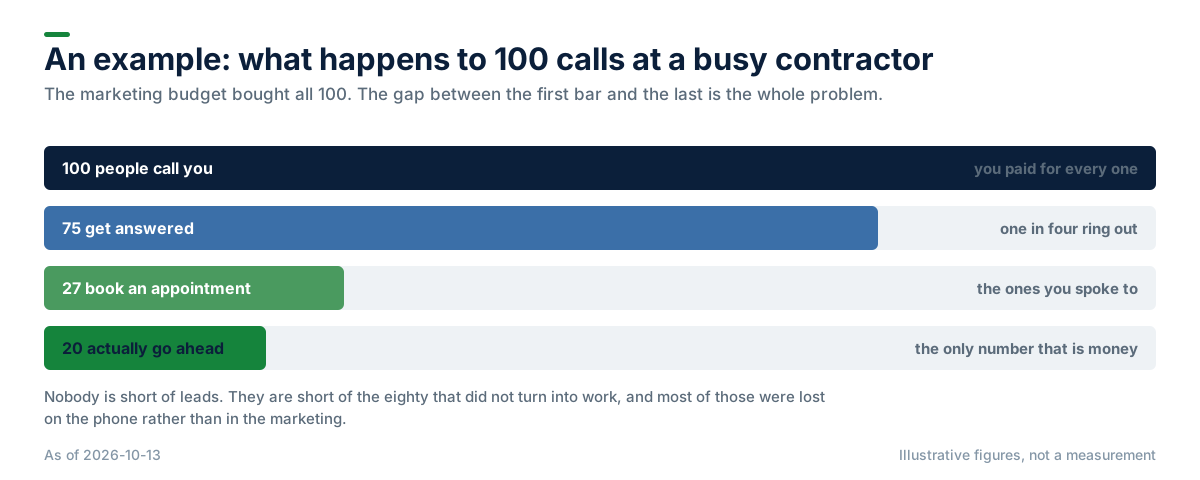
Every one of those hundred calls was bought. Somebody saw a van, a Google listing, a neighbor's recommendation, an ad. That cost money or years of reputation, and all of it had already been spent before the phone rang.
In this example one in four of them rang out, because everybody was on a roof. That is not far-fetched; it is about the average. Invoca's call data puts it at 27% of calls to home-services businesses going unanswered (2023, repeated in 2024).
Most of those callers do not leave a voicemail, and most of them try somebody else. In a 2025 CallRail survey of 1,000 US consumers, only 42% said they leave a voicemail, and 82% said they will call a competitor if a business does not answer.
Why buying more leads makes it worse
The instinct is to turn the tap up. More ads, a lead-buying service, another directory listing.
But if only three in four of your calls get answered today, buying another hundred calls means you now miss fifty instead of twenty-five. You have paid twice for the same leak.
Worse, bought leads are the weakest kind. A shared lead from a directory is often sold to several of your competitors, and the homeowner is waiting for whoever rings back first. You are buying a race you usually lose because you are under a house with your phone in the van.
Catch the leads you already have
The cheapest lead is the one that already called you. There are three moments where most of them are won or lost, and all three happen when nobody is free.
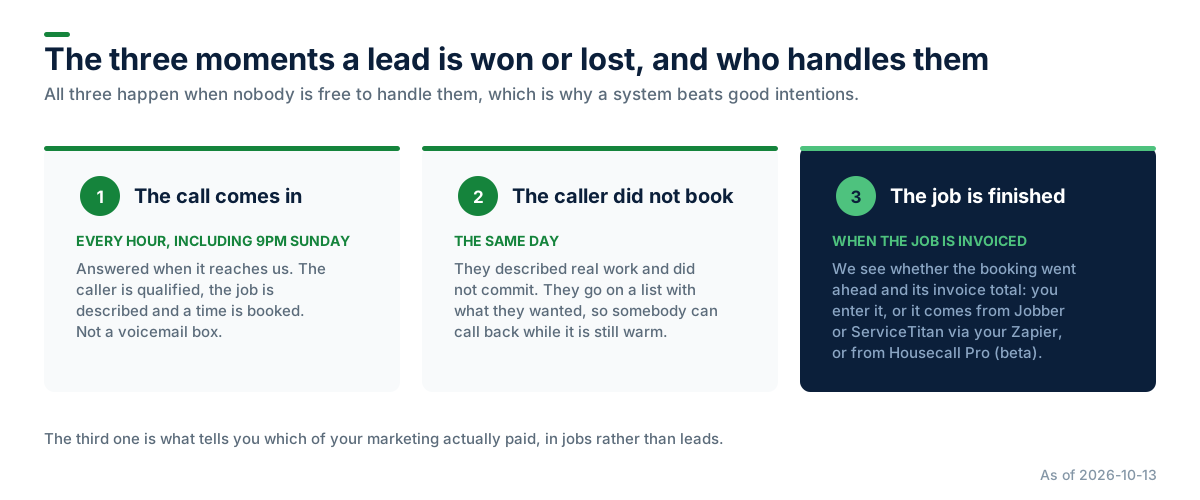
The call gets answered. Your AI receptionist answers your calls around the clock. It asks what is wrong, where they are and when suits them, then books the job on your calendar. It knows your prices, your service area and what you do not take on. At nine on a Sunday the caller talks to somebody instead of a voicemail box.
The ones who did not book get followed up. Some callers describe real work and then hesitate. They land on a list with what they wanted and what they said, so somebody can ring them back the same day, while they still remember you.
Your old customers hear from you. The list you already own is the warmest one there is. Once your text-message registration is approved, CaughtLeads can reach back out to past customers who gave you written consent to hear from you. Nobody else is contacted.
One more thing is worth doing yourself, and CaughtLeads does not do it for you: when a job is paid, ask that customer for a Google review, by text only if they agreed to hear from you. If you use Jobber or Housecall Pro, they can send the request for you. How to ask properly is in how to get more Google reviews.
The part most tools skip
Plenty of software will tell you how many leads you got. Very few will tell you which ones turned into money.
We track every booking through to whether the customer actually went ahead and what the job was worth. The total is the one you enter, or it comes back from Jobber or ServiceTitan through your own paid Zapier account, or from Housecall Pro direct (beta). Not an estimate typed on the phone. The real figure.
That matters because it changes which number you manage. Cost per lead is a vanity metric. Cost per job you actually did and got paid for is the one that tells you where to spend next month.
What this looks like in your week
Nothing changes about how you work, which is the point.
You keep your own number and forward the calls you miss. Your phone rings as it always has. You choose how long it rings before your forwarding sends it to the receptionist instead of voicemail, so a booking can be on your calendar before you are back in the van.
You open the dashboard on Friday and see what came in, what got booked, what held, and what it was worth.
Start with the leak, not the tap
If you are about to spend more on ads, do one thing first. Pull last month's call log and count the calls that rang out during your busy weeks. Multiply that by your average job.
It is your number, not ours, and it can be bigger than the ad budget that caused the problem.
Once fewer calls ring out, new leads have a real chance of turning into work. Until then, more of them just make the leak louder.
The broader case for working your existing demand is in how to get HVAC leads.
Never miss another lead like the ones in this story
Try it free: we'll fine-tune an AI receptionist to your business, then test it on a real call.
Try it freeMore Field Notes
 Guides
How to Get More Google Reviews Without Breaking Google's Rules
Reviews are the Google Maps ranking input a contractor can most directly influence. Here is when to ask, what to send, the shortcut that can get your reviews taken down, and how to keep it going.
 Playbook
Your Best Blog Topics Are Sitting in Your Phone Calls
Contractors pay agencies to guess what customers search for. Your callers tell you every day, in their own words. Here is how to turn last month's calls into pages worth publishing.
 Guides
Local SEO for Contractors: What Works and How Long It Takes
As a rough rule of thumb, reviews can move in weeks, pages can take months, and ads stop the day you stop paying. An honest timeline for local SEO, the order to do it in, and how to spot a bad agency.