Guides
How to Get More Google Reviews Without Breaking Google's Rules
CaughtLeads · CaughtLeads · October 13, 2026
Reviews are the Google Maps ranking input a contractor can most directly influence. Here is when to ask, what to send, the shortcut that can get your reviews taken down, and how to keep it going.

You have eleven reviews. The company above you has 214
Search your own trade and your own town on your phone. Look at the three companies in the map box at the top, then look at their review counts.
That number is often a big part of the difference. Not a better website, not a bigger ad budget. They asked, and you did not.
The frustrating part is that you earned far more than eleven. You have done hundreds of jobs. Plenty of those customers would have left a review if somebody had asked at the right moment, and nobody did.
Reviews are not a vanity number, they are a ranking input
Google is unusually open about this. It says local results are mainly based on three things: relevance, distance and prominence, which is how well known a business is.
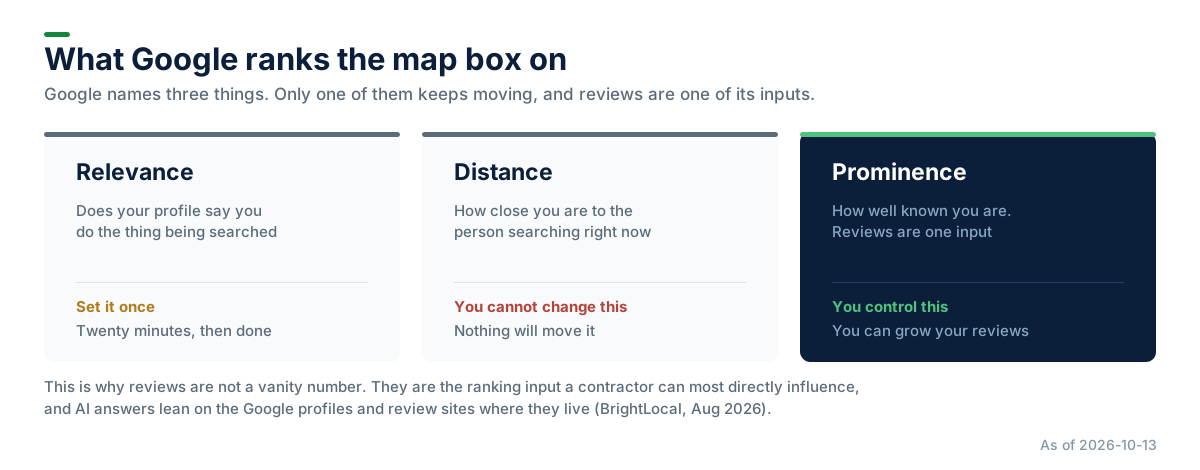
Relevance is a one-time fix. Make sure your profile lists the services you actually sell, and you are done.
Distance you cannot change at all. You are where you are.
Prominence is how well known you are. Google names reviews as one of its inputs, alongside things like how many websites link to you. Of everything in it, reviews are the one you can most directly influence, and they keep moving every week.
There is a second reason it matters more now than it did two years ago. When somebody asks an AI assistant to recommend an HVAC company near them, the answer draws heavily on Google Business Profiles and review sites like Yelp (BrightLocal, August 2026), which is where your reviews live.
Why it never happens
The method is not complicated. Ask every customer who paid you, about an hour after the job is done, with a direct link to the review box. Send it by text only if they agreed to hear from you that way. Reply to everything that comes back.
None of that is hard. Few people keep it up.
The reason is that it is one more thing at the end of a long day. The job finishes at six, you are already late, and texting a review link is the last item on a list that was too long at eight in the morning. By week three the habit is gone and the count stops moving.
That is not a discipline problem. It is a habit that needs a fixed trigger, not willpower.
Make it part of how every job closes
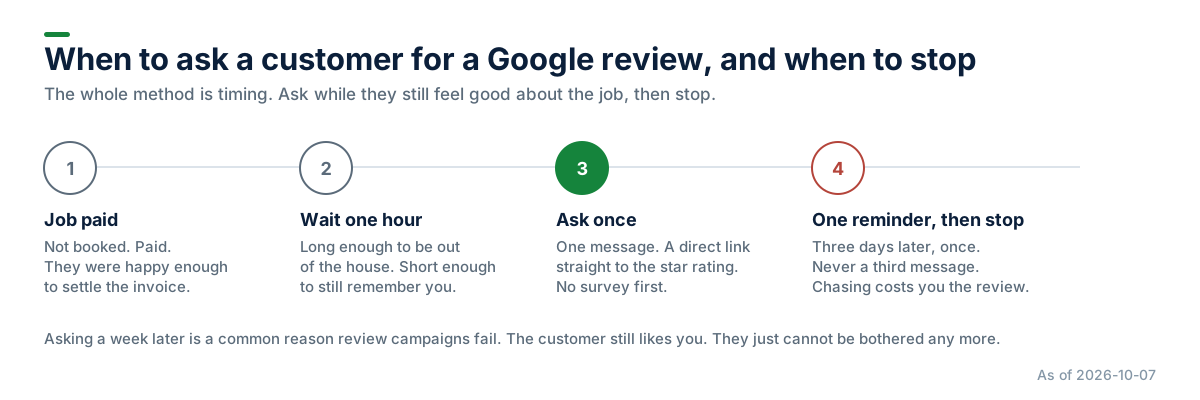
Use the paid invoice as the trigger. Not the booking, not the appointment. Money changed hands, which means the customer was satisfied enough to settle up.
Ask within the hour. Long enough for you to be out of the house, short enough that they still remember you. One message, with a direct link to the star rating.
One reminder, then stop. Three days later, once, if nothing came back. A third message costs you the review and sometimes the customer.
Reply to every review. Google recommends replying to reviews, good and bad. A calm, specific reply under an angry review tells the next customer more about you than a wall of five stars with nothing underneath any of them.
The shortcut that can get your reviews taken down
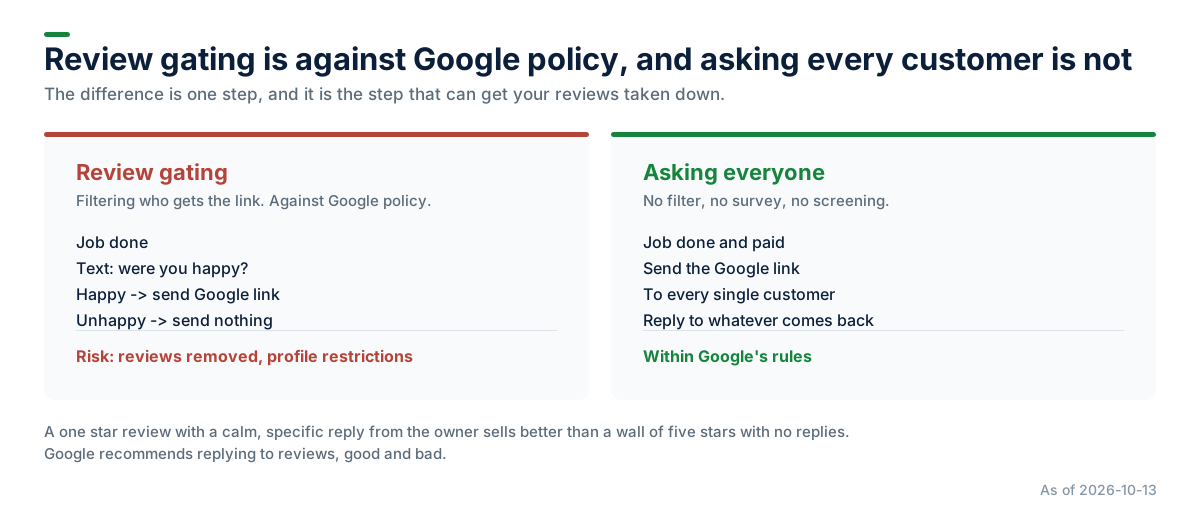
Somebody will tell you to text the customer first, ask whether they were happy, and only send the Google link to the ones who say yes.
Do not do this. It is called review gating, and Google's review policy bans it in so many words: businesses must not "selectively solicit positive reviews from customers". Google removes reviews gathered this way, and for fake-review violations it can block new reviews for a period, hide existing ones and show a warning on your profile.
The US Federal Trade Commission's 2024 rule on fake reviews does not name gating, but the FTC says gating can still be deceptive under the FTC Act. The rule itself, in force since late 2024, bans fake reviews, paying for reviews that have to be positive, reviews from staff or family that do not disclose their connection to you, and using threats or false accusations to get bad reviews removed. Fines run up to $53,088 for each knowing violation (the 2025 figure, unchanged for 2026).
So ask everybody. Never write one, never pay for a good one, never hide a bad one. That is the honest version and it is also the safe one.
What to do this week
You need twenty minutes.
- Claim your Google Business Profile if you have not. It is free.
- Find your review link in the profile and save it to your phone's notes.
- Text it to the last ten customers who paid you, gave you their mobile number and agreed to hear from you. Just the link and one line. (If you send it from texting software rather than your own phone, get that agreement in writing.)
- Reply to every review you already have, including the bad ones.
Doing it by hand for a week will also show you how easy it is to let slide, which is why it belongs in how every job closes rather than on a to-do list.
Where this fits
Reviews are one of the quickest things on the list to start. They cost nothing but the asking, and every customer who looks you up sees them.
If the phone is already ringing and the problem is that nobody answers it, start with catching the leads you already have instead. And if you want the honest timeline for the slower half, local SEO for contractors lays it out.
Never miss another lead like the ones in this story
Try it free: we'll fine-tune an AI receptionist to your business, then test it on a real call.
Try it freeMore Field Notes
 Guides
HVAC Lead Generation: Why More Leads Won't Fix Your Problem
Struggling to find leads for your HVAC business? Most contractors already have more than they think. Here is where they go, and how to catch the ones you already have.
 Playbook
Your Best Blog Topics Are Sitting in Your Phone Calls
Contractors pay agencies to guess what customers search for. Your callers tell you every day, in their own words. Here is how to turn last month's calls into pages worth publishing.
 Guides
Local SEO for Contractors: What Works and How Long It Takes
As a rough rule of thumb, reviews can move in weeks, pages can take months, and ads stop the day you stop paying. An honest timeline for local SEO, the order to do it in, and how to spot a bad agency.