Guides
Local SEO for Contractors: What Works and How Long It Takes
CaughtLeads · CaughtLeads · October 13, 2026
As a rough rule of thumb, reviews can move in weeks, pages can take months, and ads stop the day you stop paying. An honest timeline for local SEO, the order to do it in, and how to spot a bad agency.

Somebody promised you page one in sixty days
Every contractor has had this call. An agency rings, says your website is not optimized, and promises first-page results in sixty or ninety days for a fixed monthly fee.
Ninety days later there is a report full of charts, the phone rings about as much as it did before, and the only honest number on the page is the invoice.
The problem is not that SEO does not work. It is that three completely different things get sold as one thing, on one timeline, and only one of them is fast.
Three different clocks, sold as one
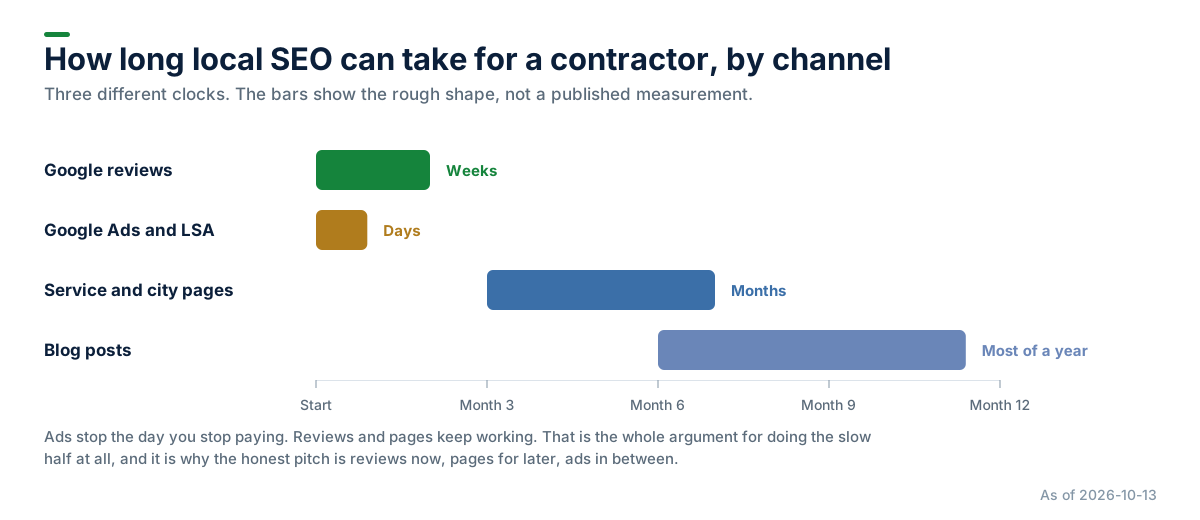
As a rough rule of thumb, and not a promise:
Ads can work in days. You pay, you appear, the phone can ring. Stop paying and it stops that afternoon. You are renting the customers, which is fine as long as you know that is what you are doing.
Reviews can work in weeks. Ask every paying customer who agreed to hear from you, not only the ones you think were happy. It is free, and for most contractors it is one of the fastest real improvements available.
Service and city pages can take months, blog posts often most of a year. Then they keep working without further payment. This is the slow half, and it is the half many agencies sell first, because it is the biggest invoice.
Anyone who quotes you one timeline for all three is either confused or counting on you being confused.
Do it in this order
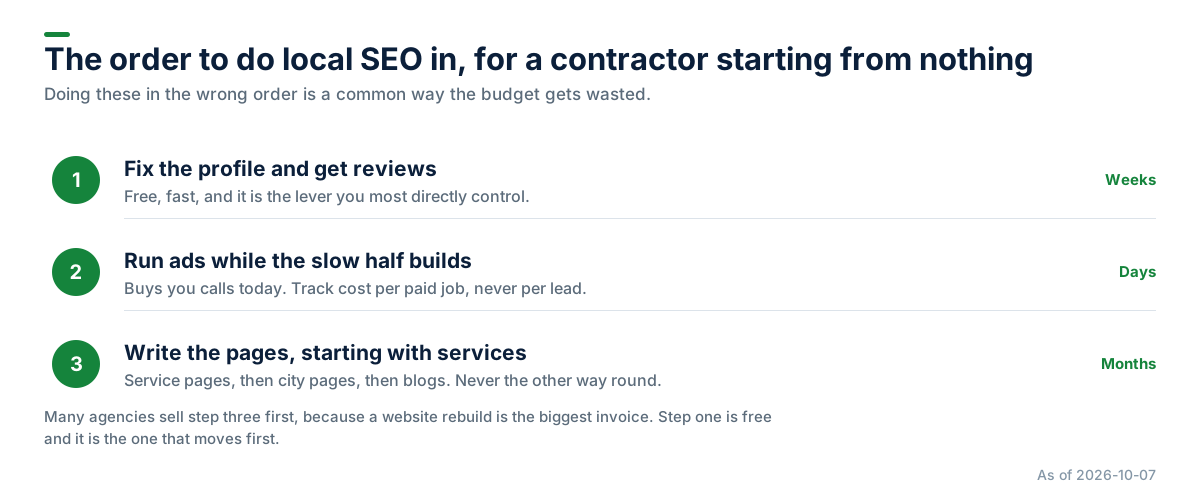
Fix the profile and get reviews first. Free, fast, and the lever you most directly control. If you do nothing else on this page, do this. The detail is in how to get more Google reviews.
Run ads while the slow half builds. This is the right use of ad spend: covering the gap until the free channels start carrying the load. Track cost per paid job, never cost per lead. A source that produces cheap leads and no paid work is worse than no source, because it also eats the time of whoever chases them.
Write the pages last, starting with services. Service pages, then city pages, then blog posts, built from what your own callers actually ask.
How to tell a real agency from a bad one
Four questions that sort it out quickly.
What will you do in the first thirty days? If the answer is a website rebuild rather than the Google Business Profile, they are selling the biggest invoice rather than the fastest result.
How will you measure it? If the report is rankings and impressions rather than booked jobs, they have chosen a number that always goes up.
What happens if I stop paying in month four? An honest answer is that the pages keep working and the ads stop. Anybody who cannot say that out loud is selling rented traffic as though it were owned.
Will you put the timeline in writing? A straight answer gives reviews and pages different clocks. If they promise page one in sixty days, that is the end of the conversation.
The part nobody puts in the proposal
All of this can make the phone ring. None of it answers the phone.
This is the quiet failure in most contractor marketing. Say the ads work, the reviews come in, the pages rank and the phone rings more than it used to. About one in four calls to home-services businesses still goes unanswered (Invoca, 2024), often because everybody is on a roof.
In a 2025 CallRail survey of 1,000 US consumers, only 42% said they leave a voicemail and 82% said they will call a competitor if a business does not answer. So the money you spent on being found can pay for a lead a competitor closes, and the report still says the campaign worked, because the report counts calls and not jobs.
What we do about it
We started by answering the phone, because that was the leak nobody was fixing.
An AI receptionist can pick up when you cannot, day or night. It takes the caller's details and can book the visit into one of your open slots.
And we show you which ones held. The job total is the one you enter, or it comes back from Jobber or ServiceTitan through your own paid Zapier account, or from Housecall Pro direct (beta), rather than an estimate typed on the phone.
That second part is what lets you judge the rest of this page honestly. Reviews, ads and pages can all make the phone ring. Knowing which calls turned into paid work is how you tell which of them was worth the money.
The honest summary
The same rough rule of thumb, not a promise:
- Reviews: can move in weeks. Free. Start here, today.
- Ads: can work in days. Costs money the whole time. Use them to cover the gap.
- Pages: can take months, blog posts often most of a year. Slow, then they keep working.
- Answering the phone: the part where being found can turn into booked work.
Anyone who tells you the slow half is fast is selling. Anyone who tells you the fast half is not worth doing has not looked at a map box recently.
Before you spend anything more on being found, make sure you are catching what you already have. That case is made properly in HVAC lead generation.
Never miss another lead like the ones in this story
Try it free: we'll fine-tune an AI receptionist to your business, then test it on a real call.
Try it freeMore Field Notes
 Guides
HVAC Lead Generation: Why More Leads Won't Fix Your Problem
Struggling to find leads for your HVAC business? Most contractors already have more than they think. Here is where they go, and how to catch the ones you already have.
 Guides
How to Get More Google Reviews Without Breaking Google's Rules
Reviews are the Google Maps ranking input a contractor can most directly influence. Here is when to ask, what to send, the shortcut that can get your reviews taken down, and how to keep it going.
 Playbook
Your Best Blog Topics Are Sitting in Your Phone Calls
Contractors pay agencies to guess what customers search for. Your callers tell you every day, in their own words. Here is how to turn last month's calls into pages worth publishing.