Comparison
Ruby Receptionist Alternatives for Contractors: Prices Compared
CaughtLeads · CaughtLeads · October 13, 2026
Ruby is a well-known human receptionist service, priced by the minute. Here is what it costs, what the alternatives cost, and when a contractor is better off with a person or an AI.

Ruby is good. The bill is the problem
Ruby is one of the best-known receptionist services in the US. Real people answer your phone, take messages and book appointments, and plenty of small businesses are happy with it.
Contractors usually go looking for something else for one reason: the bill. Trade calls run long. A homeowner describing a leak, a noise or a dead unit takes a few minutes, and on a per-minute plan every one of those minutes is charged.
Ruby sells blocks of minutes: $250 a month for 50, $395 for 100, $720 for 200 and $1,725 for 500. On the 200-minute plan that is $3.60 a minute. A shop taking 80 calls a month at about two and a half minutes each uses all 200.
Every price here is from each company's own pricing page, checked on 8 October 2026 (Goodcall's on 12 October). Prices change, so check again before you sign up.
What the same month costs elsewhere
Here is that same month, about 200 minutes or roughly 80 calls, priced on five other services.
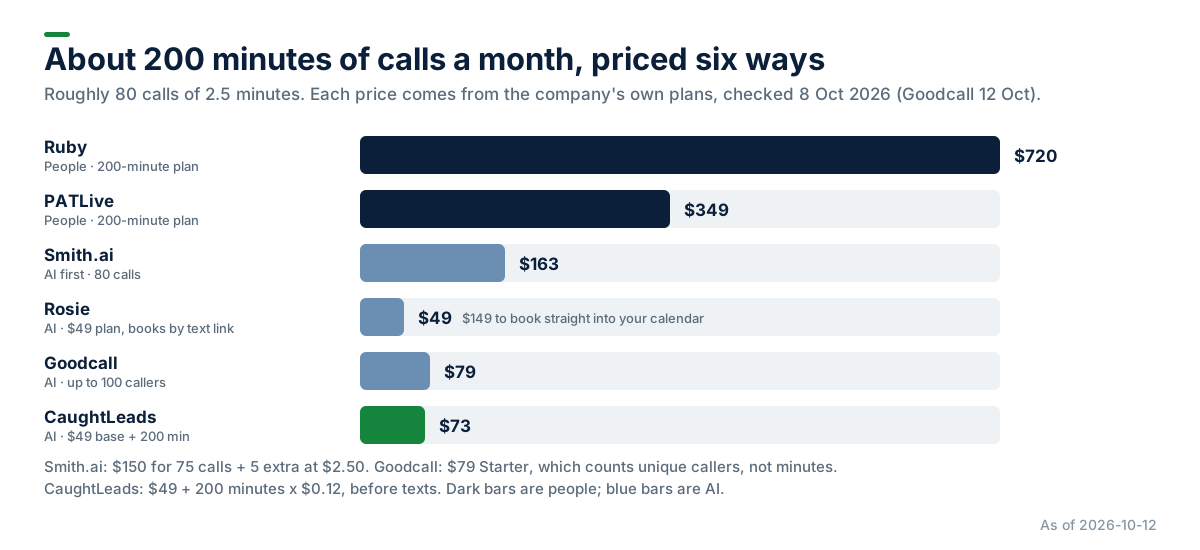
PATLive (people). Another live receptionist service. Its 200-minute plan is $349 a month, with extra minutes at $1.99.
Smith.ai (AI first, people available). Its AI receptionist charges per call: $150 a month covers 75 calls and extra calls cost $2.50 each, so about 80 calls comes to roughly $163. Its human receptionist plans start at $300 for 30 calls.
Rosie (AI). $49 a month covers 250 minutes. Booking straight into your calendar starts on the $149 plan, which covers 1,000 minutes.
Goodcall (AI). Bills by unique caller rather than by minute: $79 a month covers 100 different callers, then 79 cents for each extra one.
CaughtLeads (AI, that is us). A $49 monthly base plus $0.12 a minute. 200 minutes comes to $73 a month, plus $0.03 for any text segment sent to a customer once your business's text registration is approved.
The gap is big. But price is only half the choice.
A person or an AI
The other half is who you want your customers to hear.
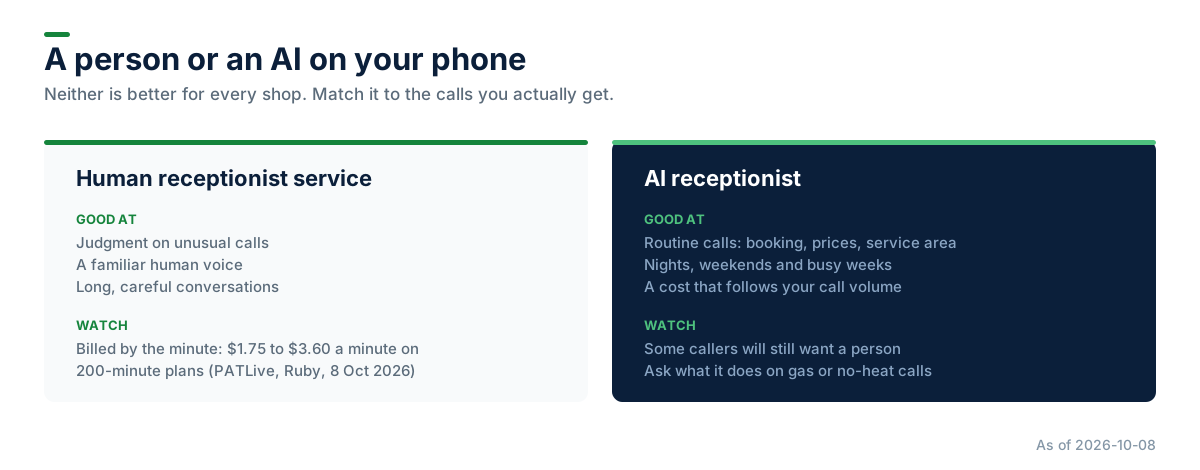
A person is the better fit when your callers need judgment a script can't give, you sell high-value work where a warm voice matters, or your calls are few and long.
An AI is the better fit when you get a steady flow of routine calls (booking, prices, service area, "can you come today"), many of them come after hours, and you want the cost to follow your call volume.
Some services mix the two. Smith.ai answers with AI first and can pass a call to a live person. We can transfer a caller to your own team when they ask for a person.
Five questions before you switch
Does it book, or only take messages? A message is a callback you still have to make. A booking is an appointment on your calendar.
What happens on an emergency call? Ask exactly what it does when a caller smells gas, or has no heat in January.
What does a long call cost? Check the rate once you pass your allowance, and whether you pay for minutes or calls you never use.
Does it work with your software? Ask how it connects to Jobber, ServiceTitan or Housecall Pro, and whether that needs another paid tool.
Can you see what happened next? Calls answered are easy to count. Which bookings actually went ahead is the number that matters.
What we do about it
We built CaughtLeads for home-services businesses. The receptionist answers in a natural voice, tells callers it is an AI, asks what is wrong and where the job is, and books the appointment into one of your open slots.
If a caller mentions a gas smell or a carbon monoxide alarm, it tells them to get somewhere safe and call 911, then emails you and phones the emergency contacts who agreed to take these calls.
Then we show you which bookings were kept and what each job was worth, from the final invoice total. You enter that total, or it comes back from Jobber or ServiceTitan through your own Zapier account, or from Housecall Pro directly (in beta).
We are not a human service. If your customers need a real person on every call, Ruby, PATLive or Smith.ai's human plans are the better choice.
The honest summary
- Ruby: real people, from $250 a month for 50 minutes.
- PATLive: real people, $349 for 200 minutes.
- Smith.ai: AI first with people available, billed per call.
- Rosie and Goodcall: AI, low monthly prices with different limits.
- CaughtLeads: AI for home services, $49 a month plus $0.12 a minute.
You can try our receptionist in your browser for free, with no card. Call it the way a customer would before you change anything.
For a closer look at the service AI assistants recommended most in our own test, read CaughtLeads vs Smith.ai.
Never miss another lead like the ones in this story
Try it free: we'll fine-tune an AI receptionist to your business, then test it on a real call.
Try it freeMore Field Notes
 Guides
HVAC Lead Generation: Why More Leads Won't Fix Your Problem
Struggling to find leads for your HVAC business? Most contractors already have more than they think. Here is where they go, and how to catch the ones you already have.
 Guides
How to Get More Google Reviews Without Breaking Google's Rules
Reviews are the Google Maps ranking input a contractor can most directly influence. Here is when to ask, what to send, the shortcut that can get your reviews taken down, and how to keep it going.
 Playbook
Your Best Blog Topics Are Sitting in Your Phone Calls
Contractors pay agencies to guess what customers search for. Your callers tell you every day, in their own words. Here is how to turn last month's calls into pages worth publishing.