Guides
SEO vs AEO for Contractors: What's the Difference, and Do You Need Both?
CaughtLeads · CaughtLeads · November 10, 2026
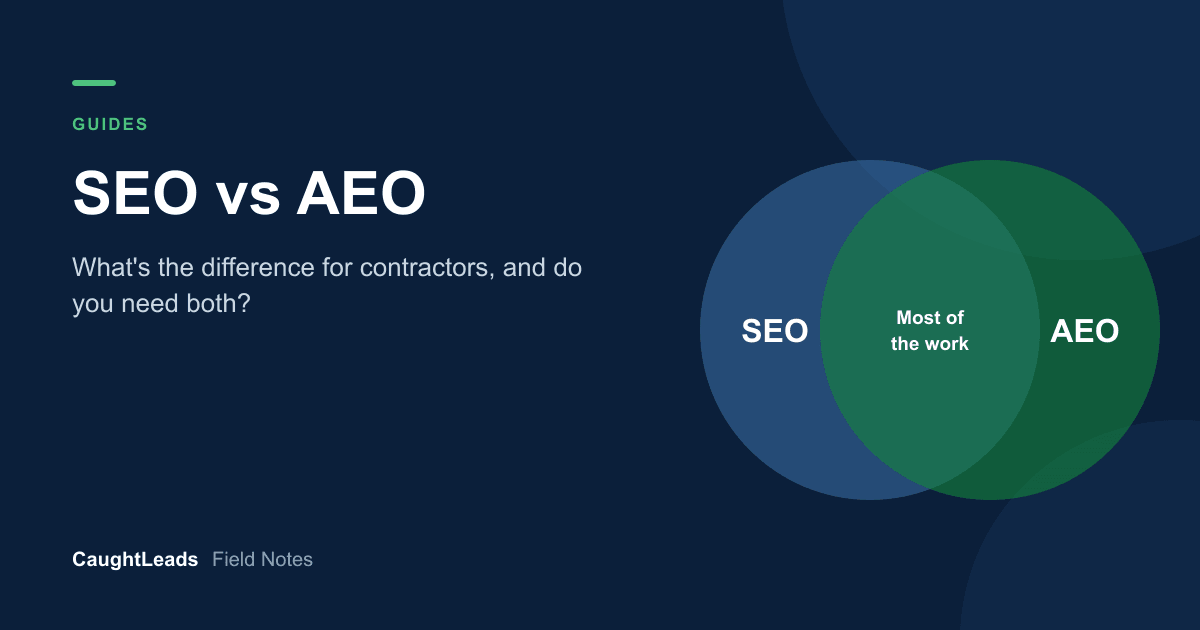
SEO gets you into Google's results and map box. AEO helps AI assistants name you when a homeowner asks who to call. Most of the work is the same. Here is where they differ, where each one shows up, and how long each takes.
Two new letters on every agency pitch
If you have talked to a marketing agency this year, you have probably heard "AEO" or "GEO" next to SEO. Some pitches make it sound like a whole new thing you need to pay for separately. Others say it is just SEO with a new name.
For Google's own AI answers, Google itself says it is still SEO. Tools like ChatGPT publish much less about how they work, so a few extra checks are worth doing. Here is the plain version.
The short answer
SEO (search engine optimization) is the work of showing up when someone searches Google: the map box with a few local businesses, and the list of websites under it. Success looks like a click or a call.
AEO (answer engine optimization) is the work of being named when someone asks an AI tool a question: ChatGPT, Google's AI answers, Perplexity or Claude. Success looks like your business named in the answer. You will also hear it called GEO, short for generative engine optimization. Same idea.
Do you need both? Most contractors do. The good news is that most of the work is shared, so one piece of work helps in both places.
Side by side
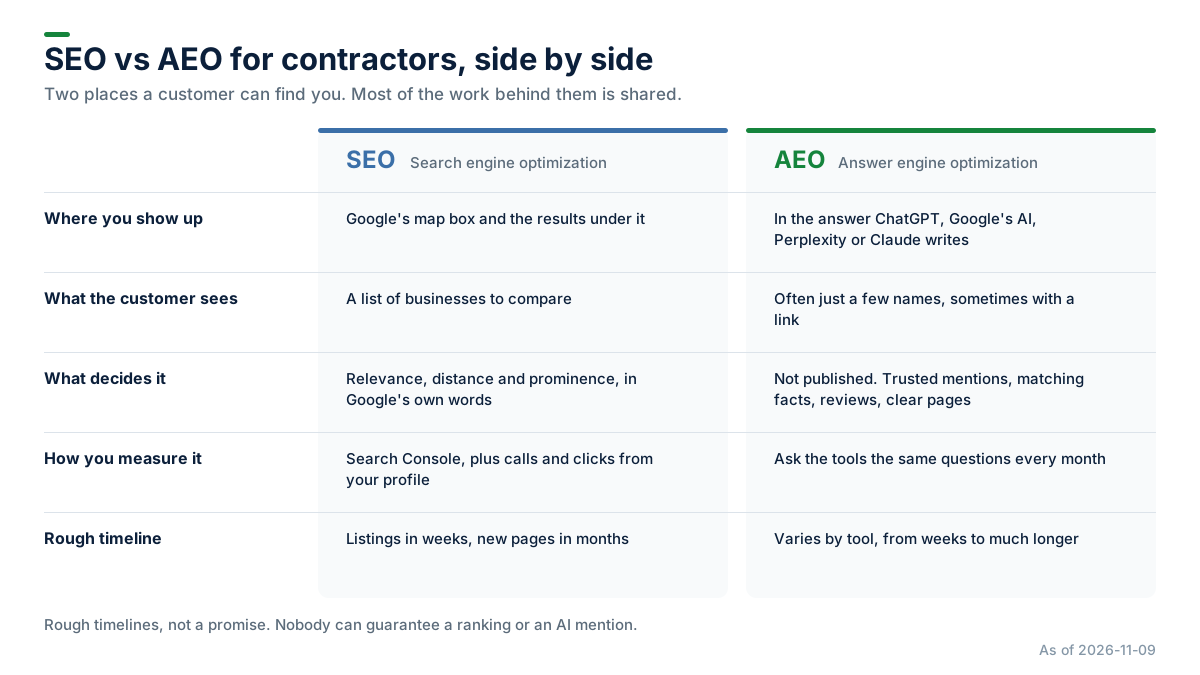
Where you show up. SEO puts you in Google's map box and search results. AEO puts you inside the written answer an AI tool gives, sometimes with a link, sometimes just your name.
What the customer sees. With SEO, they see a list and pick from it. With AEO, the tool often names only a few businesses. If you are not one of them, you may not get a look at all.
What decides it. Google says local results are based mainly on relevance, distance and prominence (how well known a business is), and that its AI answers use the same signals as its regular results. ChatGPT, Perplexity and Claude say much less, but they appear to lean on the same kind of signals: trusted sites that mention you, facts that agree, reviews, and pages that answer the question. We explain how in what AEO is and why ChatGPT may not name you.
How you measure it. SEO has real tools. Google Search Console shows which searches you appear for and how many clicks you get, and your Google Business Profile shows call-button taps and direction requests. AEO is harder to measure. One honest method is to ask the tools the questions your customers ask, in your town, every month, and write down who gets named. You can also count visits that arrive from AI tools, which often tag their links.
Where they overlap
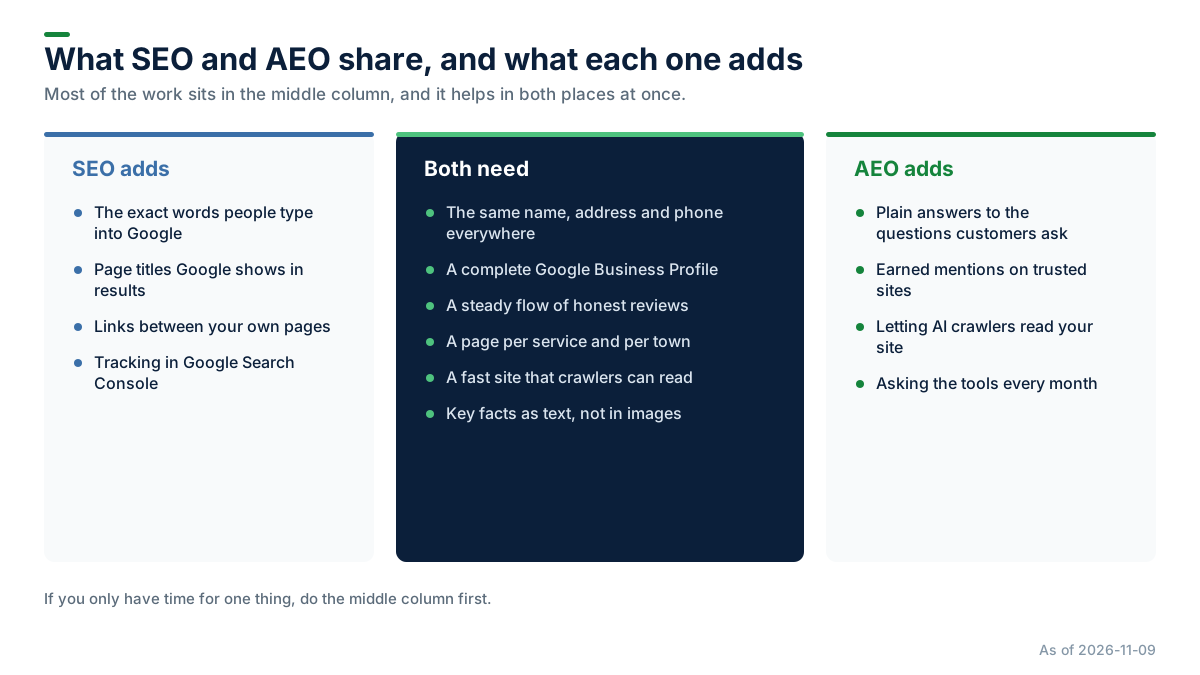
Both need the same foundation:
- The same name, address and phone number on every listing.
- A complete Google Business Profile.
- A steady flow of honest reviews.
- A page for each main service and each town you really serve.
- A website that loads fast on a phone and that crawlers can read.
SEO adds attention to the exact words people type into Google, the page titles Google shows in results, how your own pages link to each other, and structured data: code that labels your business facts and can make you eligible for richer Google results.
AEO adds pages that answer common questions plainly, which helps readers and gives any tool a clear answer to quote. It adds earned mentions on trusted local and trade sites, not only your own. And it means checking that your site lets AI crawlers in, because some sites block them without the owner knowing.
The AEO work should not hurt your Google results. Clear answers and consistent facts help a person reading your page too.
Honest timelines
As a rough rule of thumb, and not a promise:
- Fixing listings and crawler blocks: weeks.
- Reviews: weeks to get started, then a steady habit.
- New service and city pages in Google: months.
- AI answers: it depends on the tool, from weeks to much longer.
Why the range on AI answers? Some tools search the web live when you ask, so they can pick up a change fairly soon. Others lean on what they learned in training, which can be months old. The Google side is covered in more detail in local SEO for contractors.
Nobody can guarantee a ranking or an AI mention. If someone does, ask them to put it in writing and explain how they would even know.
So do you need both?
If you only have time for one thing, do the shared foundation. It helps you in both places at once.
After that, look at where your calls come from. If most of them come from the map box, keep Google first. If customers tell you they asked an AI tool, or you find competitors named every time you ask, the AEO extras are worth doing.
For most small shops it is not one or the other. It is one job with two scoreboards.
What neither one does
Neither SEO nor AEO answers the phone. Being found only pays when the call gets picked up and booked.
That is where CaughtLeads started. Our AI receptionist answers your calls day and night, books the appointment and shows which booked appointments actually happened. It is $49 a month including a local number, plus $0.12 a voice minute and $0.03 a text segment, with no setup fee. The details are on our pricing page.
Where to start
- Ask Google and an AI tool the same question about your service and town, and compare.
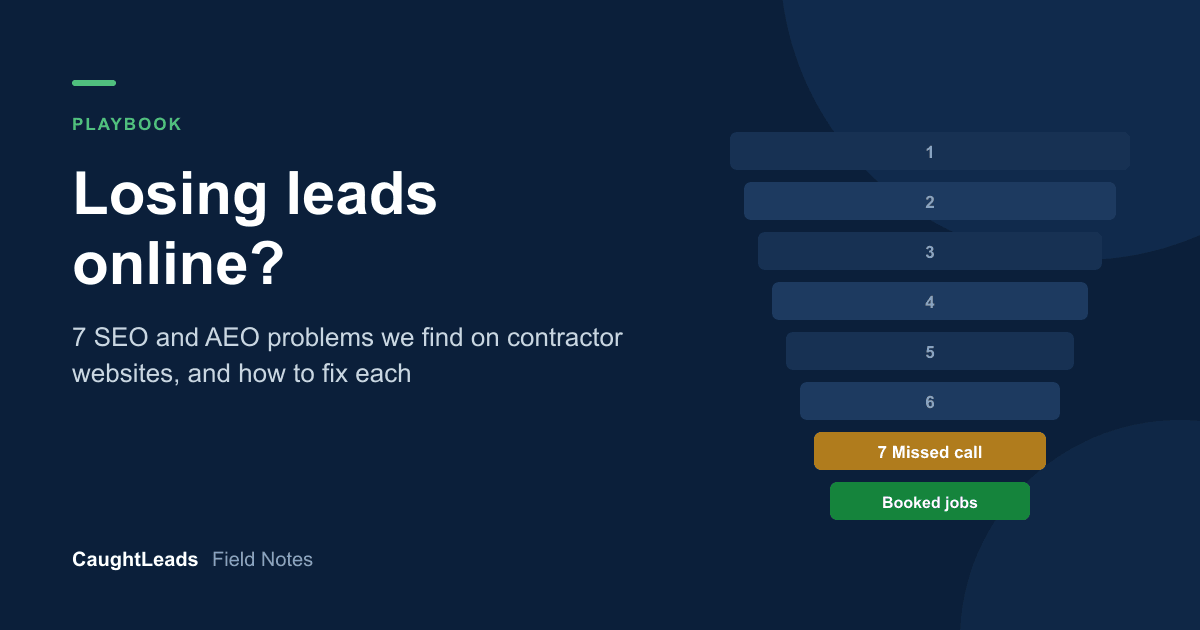
- Check the 7 SEO and AEO problems we find on contractor websites.
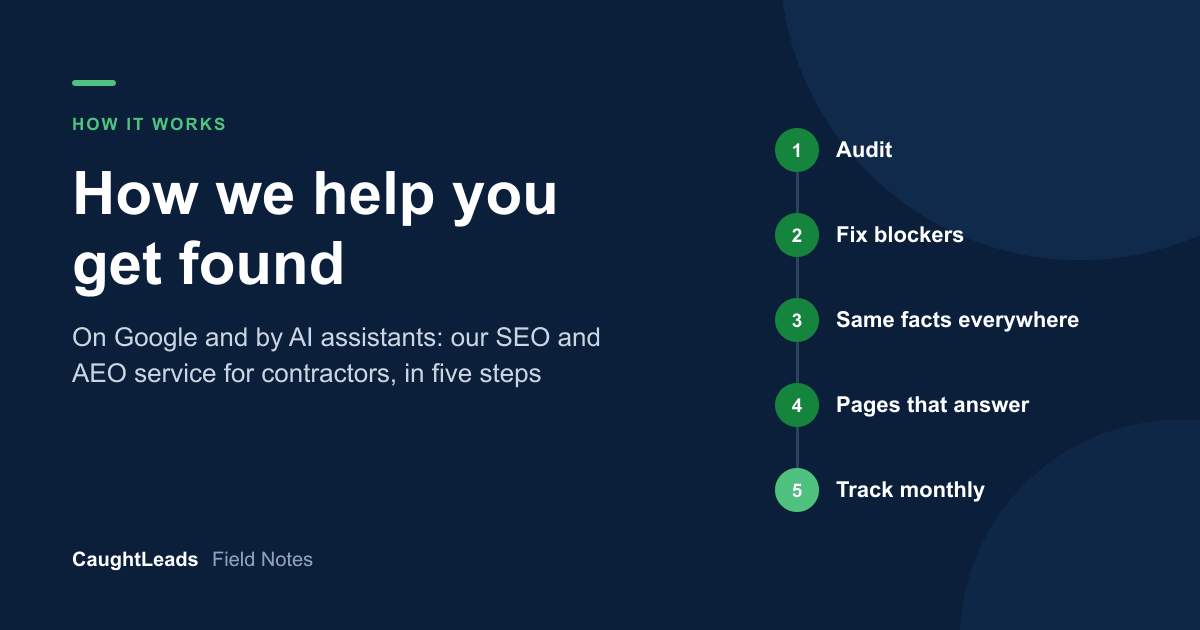
- See how our SEO and AEO service works, or read the full guide.
- Or start with a free check.
Never miss another lead like the ones in this story
Try it free: we'll fine-tune an AI receptionist to your business, then test it on a real call.
Try it freeMore Field Notes
 Guides
What Is AEO? Why ChatGPT Doesn't Name Your Contracting Business (and What You Can Do About It)
Some homeowners now ask an AI assistant who to call instead of scrolling Google. AEO is the work that helps those tools find you, trust your facts and name you. Here is how they pick, why you may be missing, and what to fix first.
 Playbook
Losing Leads Online? 7 SEO and AEO Problems We Find on Contractor Websites (and How to Fix Each)
Contractors who are hard to find online are rarely missing one big thing. They have a few small leaks. Here are the seven we check first, what each one looks like, why it costs you calls, and how to fix it.
 How it works
How CaughtLeads Works to Get Contractors Found on Google and in AI Answers
Our SEO and AEO service for contractors, in five steps: an audit, the fixes, matching facts everywhere, pages that answer questions, and a monthly report. What we need from you, what you get, and an honest timeline.