Guides
Who Should Answer Your Phone: a Receptionist, an Answering Service or AI?
CaughtLeads · CaughtLeads · October 26, 2026
A receptionist, an answering service or an AI receptionist: what each one costs a month, what each one misses, and three questions that tell you which one fits your shop.

The phone rings while you are on a roof
You are halfway through a job and your phone buzzes in your pocket. You can't answer it, and you know what happens next. In a 2025 CallRail survey of 1,000 US consumers, only 42% said they leave a voicemail, and 82% said they will call a competitor if a business does not answer.
So most owners reach the same point: someone else has to answer the phone. There are three ways to do it. You can hire a person, pay an answering service, or use an AI receptionist. Each one costs something different, and each one misses something different.
What each one costs
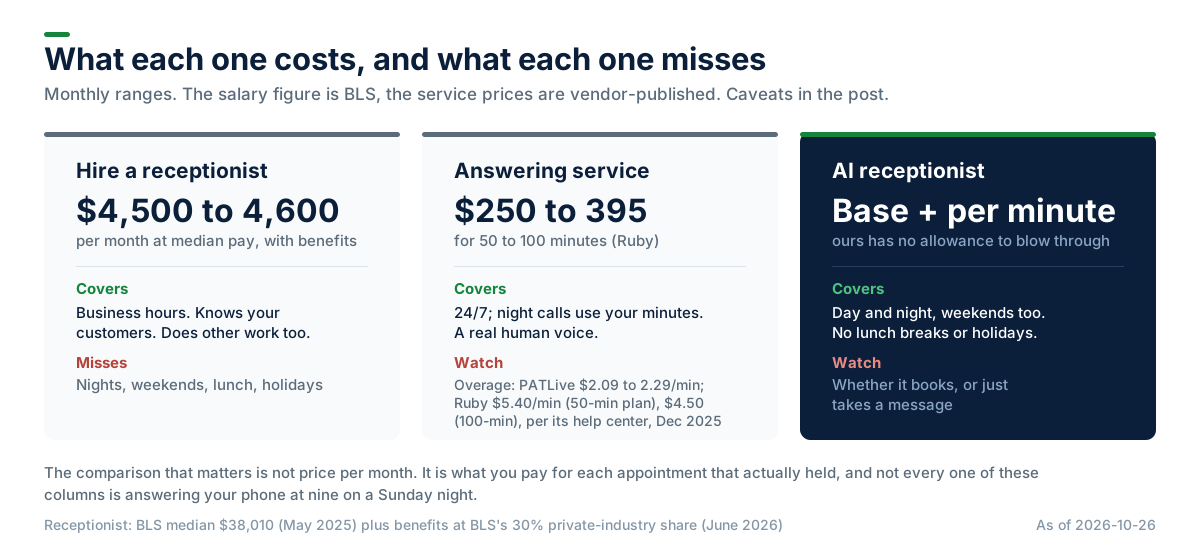
Hiring a receptionist. The median US receptionist earned $38,010 a year in May 2025 (Bureau of Labor Statistics), about $3,170 a month. Wages are 70% of what an employer pays in total and benefits are the other 30%, for private-industry workers (BLS, June 2026). So a receptionist at median pay costs about $4,500 to $4,600 a month.
An answering service. Real people answer for you, from an allowance of minutes. Ruby, a well-known service, lists $250 a month for 50 minutes and $395 for 100 minutes on its pricing page (checked 26 October 2026). Go past your allowance and extra minutes cost more; PATLive, for example, charges $2.09 to $2.29 a minute on its 50- and 100-minute plans (checked 26 October 2026).
An AI receptionist. Most charge a monthly base plus a rate per minute, or a plan with a block of minutes. Ours is a $49 base plus $0.12 a minute of talk time.
What each one misses
A receptionist misses the hours they are not at work. Nights, weekends, lunch and holidays go to voicemail unless you pay for cover. What you get in return is real: a person who knows your customers and can also do dispatch and invoicing.
An answering service misses your budget in a busy month. Most cover nights and weekends as part of the plan; those calls use your minutes. The risk is the allowance: one hot week can use up the month's minutes, and every call after that costs extra.
An AI receptionist can miss the booking. Some only take a message, and you still have to call everyone back. Ask whether it books the appointment while the caller is on the line.
Three questions that decide it
You do not need a spreadsheet to choose. Answer three questions about the shop you run today, not the one you plan to run in two years.
- Do calls come in after 6pm or at weekends?
- Do you get more than about 100 calls a month?
- Is there enough other office work to fill a full-time desk?
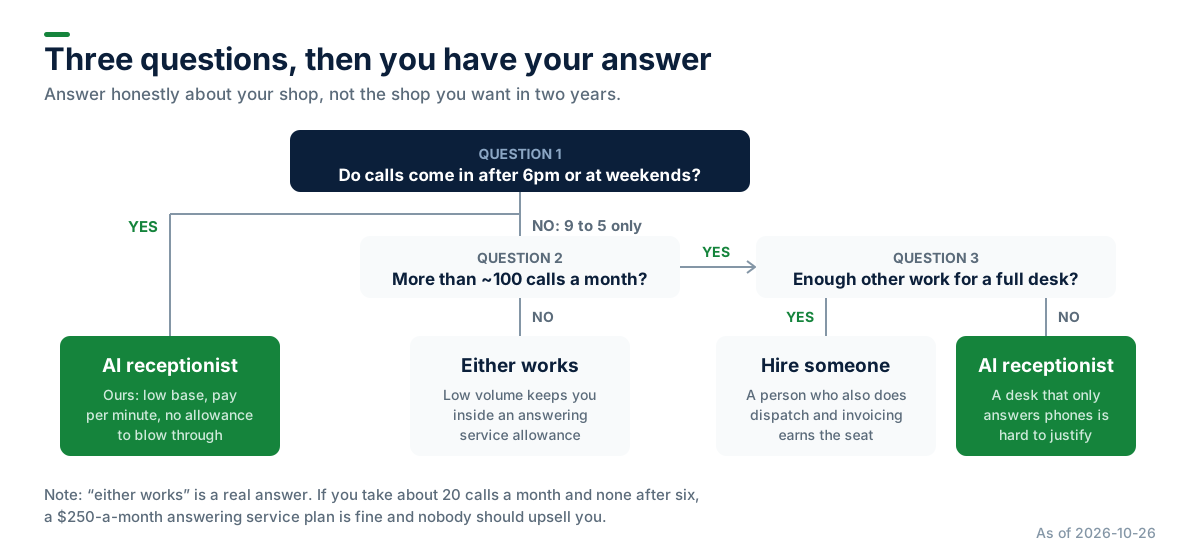
If calls come in after hours, a person on a nine-to-five shift can't catch them, so an AI receptionist covers the gap, usually for the least money. If you only get calls in business hours and not many of them, either a small answering service plan or an AI receptionist will do. If you are busy in business hours and someone could also run dispatch and invoicing, hiring a person earns the seat. If the phone is the only job that desk would do, it is hard to justify a full salary for it.
What we do about it
We built CaughtLeads for home-services trades like HVAC, roofing and plumbing.
It books, not just answers. Our receptionist asks what is wrong, where the job is and when suits the caller, then books the appointment into one of the open times you set.
Safety calls come first. If a caller mentions a gas smell or a carbon monoxide alarm, the receptionist tells them to get somewhere safe and call 911, then emails you and phones the emergency contacts who agreed to take these calls.
You see which bookings actually happened. We report which bookings were kept and what each job was worth, using the final total you enter, or that Jobber, ServiceTitan or Housecall Pro sends back.
It works alongside a person. If you already have someone at the desk, we can answer when they are busy or gone for the day, and transfer a caller to your team when they ask for a person, if you switch transfers on.
Work it out on last month's calls
- Count last month's calls, and how many came after 6pm or at weekends.
- Add up the minutes and price that month on each option.
- Call the service you are considering the way a customer would.
You can build and test our receptionist in your browser for free, with no card. For a closer look at the options for one trade, read the guide to the best answering service for HVAC companies.
Never miss another lead like the ones in this story
Try it free: we'll fine-tune an AI receptionist to your business, then test it on a real call.
Try it freeMore Field Notes
 Guides
Best Answering Service for HVAC Companies: How to Choose in 2026
Human receptionists, AI receptionists, or a mix of both. What each costs for an HVAC shop, what to ask about emergency calls, and how to pick the one that fits your call volume.
 Comparison
CaughtLeads vs Smith.ai: Which Answering Service Fits a Small Contractor?
Smith.ai is one of the best-known answering services, with both AI and human receptionists. Here is how it compares with CaughtLeads on price, how each one bills, and which kind of contractor each one suits.
 Comparison
CaughtLeads vs Rosie: Which AI Receptionist Fits a Small Contractor?
Rosie is a simple AI receptionist for small businesses, with plans from $49 a month. Here is how it compares with CaughtLeads on price, on booking, and on which kind of contractor each one suits.